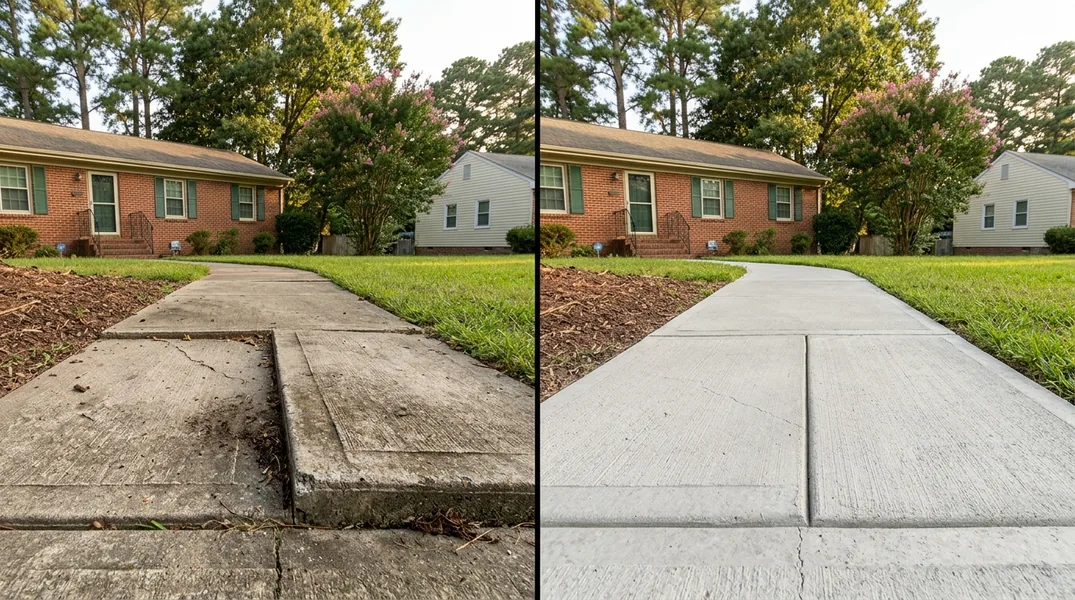
Understanding Newport News' Challenging Ground Conditions
If you own a home in Newport News, you've likely noticed something that homeowners in inland Virginia don't face quite as often: concrete problems that seem to appear out of nowhere. Your driveway cracks. Your patio sinks. Your foundation shifts. These aren't signs of poor installation or cheap materials. Instead, they're the natural result of living in a coastal region with a high water table and notoriously soft, unstable soil.
The Hampton Roads area, which includes Newport News, sits on some of the most geologically challenging terrain on the East Coast. Unlike the clay and compacted earth you find inland, our coastal soils consist largely of sand, silt, and organic matter that shift and settle over time. Add in the region's consistently high water table, and you have a recipe for concrete that moves, cracks, and sinks far more easily than it would in other parts of Virginia.
What Is a High Water Table and Why Does It Matter for Concrete
A high water table means that groundwater sits much closer to the surface than it does in most other regions. In Hampton and surrounding areas, the water table can be just a few feet below ground level, and in some neighborhoods, it rises even higher during rainy seasons or after heavy storms. This constant presence of moisture creates several problems for concrete installations.
When water saturates the soil beneath your concrete slab, it weakens the base that holds everything up. Concrete is strong in compression, but it depends on stable, well-draining soil underneath to distribute its weight evenly. Saturated, soft soil cannot provide that support. Instead, it compresses unevenly, causing some sections of your driveway or patio to sink while others remain level. This uneven settling is what creates those unsightly cracks and the buckling you see in driveways throughout the region. Over time, water infiltration also causes the concrete itself to deteriorate from the bottom up, leading to spalling, pitting, and structural failure.
Coastal Soil Concrete Cracking: Why Your Driveway Breaks Apart
The soil composition in coastal Newport News is fundamentally different from inland areas. Instead of dense, stable clay, you have sandy, silty soils with high organic content. These materials don't compact well and don't stay put. They shift, settle, and move with changes in moisture and temperature. When a concrete slab sits on top of this unstable foundation, the result is predictable: cracks develop as the soil moves beneath the surface.
Concrete cracking from coastal soil happens through several mechanisms. First, differential settling occurs when different sections of soil compress at different rates. This puts stress on the concrete, which has limited flexibility. Second, freeze-thaw cycles, while not as severe as in northern climates, still occur in the region and cause soil to expand and contract. Third, the constant moisture cycling (wet, dry, wet again) causes the soil to swell and shrink, pulling the concrete with it. The result is a network of cracks that start small but grow larger and more numerous over time, eventually compromising both the appearance and functionality of your concrete surfaces.
Concrete Settling in Hampton Roads: The Slow Sinking Problem
One of the most common issues we address at Newport News Concrete is concrete settling in Hampton Roads. Unlike a dramatic failure, settling is a slow process that homeowners often don't notice until it becomes serious. Your driveway might drop an inch or two over several years, creating a noticeable lip where the concrete meets your garage or a depression in the middle of the slab where water pools.
Settling happens because the soft, saturated soil beneath your concrete compresses over time under the weight of the slab itself. This is especially pronounced in areas with a high water table, where the soil never fully dries out and never becomes truly compact. The heavier the concrete and the softer the soil, the faster the settling occurs. In some cases, we've seen driveways and patios sink several inches over just five to ten years. This settling creates not only an eyesore but also a safety hazard, as uneven surfaces can cause trips and falls. It also allows water to pool on the surface, accelerating deterioration and creating drainage problems for your property.
Protecting Your Concrete: Proper Installation and Drainage Solutions
The good news is that understanding these challenges allows us to build concrete that lasts longer and performs better in Newport News conditions. Proper installation begins long before the concrete is poured. We start with thorough site assessment and soil preparation. This includes removing unsuitable topsoil, improving drainage, and creating a stable base using compacted stone or engineered fill. For high water table areas, we often recommend elevated installations or enhanced drainage systems that direct water away from the concrete slab.
When installing Concrete Driveways or Concrete Patios in coastal regions, we also focus on proper slope and surface preparation. A well-sloped surface ensures that water runs off rather than pooling on top of the concrete. We use thicker slabs than might be needed in other regions to provide extra strength and longevity. We also pay careful attention to joint placement and design, as properly spaced control joints help manage the cracking that will inevitably occur due to soil movement. These joints allow the concrete to move slightly without creating random, unsightly cracks.
For existing concrete that's already experiencing problems, Concrete Repair & Resurfacing options can extend the life of your investment. Mudjacking can raise sunken sections back to level, while resurfacing can restore the appearance and function of damaged surfaces. In some cases, we recommend complete replacement with proper foundation preparation to prevent the same problems from recurring.
What to Budget: Concrete Costs in Newport News' Challenging Environment
Homeowners often ask about pricing for concrete work in our region, and it's important to understand that Newport News projects typically cost more than similar work in areas with better soil conditions. The additional expense reflects the extra work required to prepare the site, improve drainage, and build concrete that can withstand our unique environmental challenges. A driveway that might cost $5,000 to $8,000 in an inland Virginia community could run $7,000 to $12,000 here, depending on the size, complexity, and site conditions.
This higher cost is an investment in longevity and performance. Cheap concrete that fails in five years is far more expensive than properly installed concrete that lasts twenty years or more. When you get a free estimate from Newport News Concrete, we'll explain exactly what makes your site unique and why certain preparation steps are necessary. We'll also discuss options for managing costs without compromising quality. Call us at (757) 244-9760 to discuss your specific project and learn what to realistically budget for your concrete needs in this challenging coastal environment.
Looking for a professional concrete contractor in Newport News? Newport News Concrete responds fast for all your concrete needs.
Get a Free QuoteOur services: Concrete Driveways · Concrete Patios · Stamped & Decorative Concrete